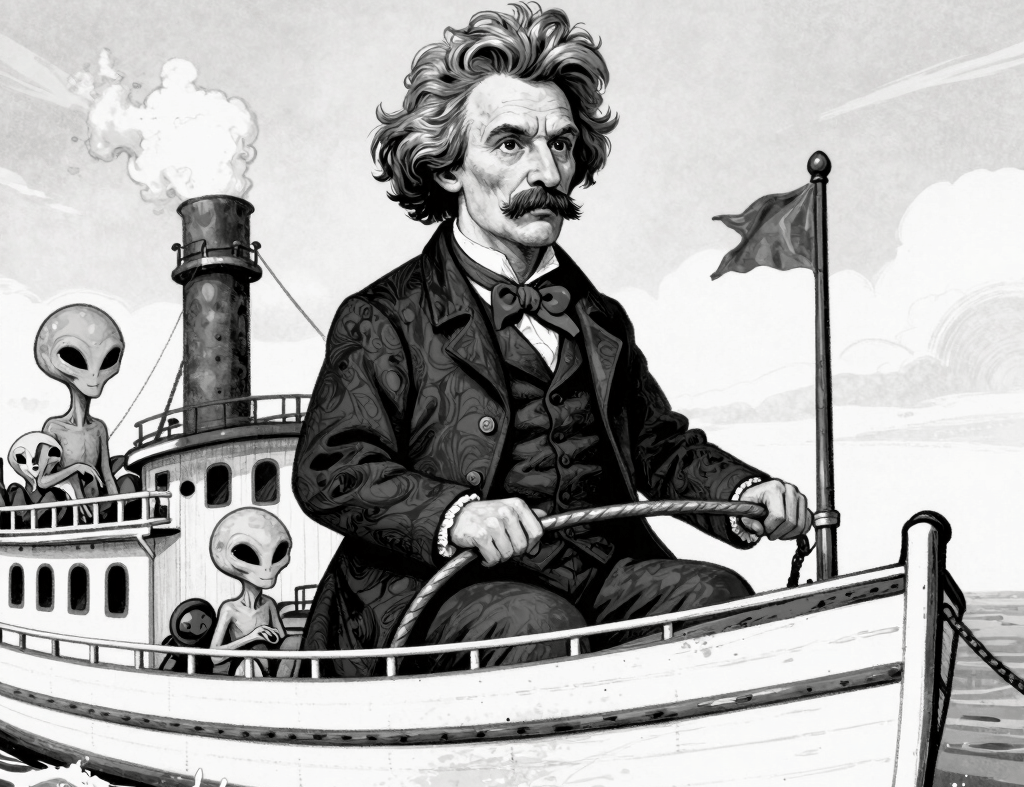
Mark Twain and Aliens
Exploring faith with the "malevolent trickster."
Matthew Galgani
That sounds more like delusion or denial to me. Or maybe the uncertainty of faith simply reflects the celestial shenanigans of what Twain called the "malevolent trickster."
But when something gets proven empirically, it no longer requires faith. It‘s simply truth. Anyone who chooses to ignore that is either delusional or in denial.
The problem is, much in life that gets passed off as fact is actually unproven opinion or in the words du jour, misinformation or disinformation. And, of course, there’s the ever-flexible my truth vs. the truth.
This concept of “faith” has nothing to do with “religion.” But it has everything to do with “belief.”
Again, once something is proven, why would it require faith? It doesn’t.
For example, if everyone was as certain that aliens live among us here on earth as they are that people age and eventually die, no one would doubt the existence of extraterrestrials.
Or would they?
Christians, for example, believe in an afterlife, and many others believe in reincarnation. Others believe in nothing beyond this physical world . But who has proven that to be true?
And while many people are convinced that aliens have visited or lived among us for aeons, others would believe it was nothing more than an AI-generated ruse even if our galactic overlords held a globally televised press conference at the United Nations.
"Faith is believing what you know ain't so."
— Mark Twain
The Fickless Of Faith and Facts
Faith is such a fickle friend. Almost as fungible as many of the facts we believe to be true.
As I wrote about in earlier blogs here and here, this is a recurring theme in my novel, Doubting Nikki — A Tale of Faith and Delusion.
To me, at least, it’s surprising how many people live with unshakable certainty that what they believe to be true is both provable and proven fact.
But whether it’s the politics of the right vs. the left, established vs. unsettled science, or the belief that some supernatural force does or does not exist, much of what we choose to accept comes down to what we choose to believe.
So while Mark Twain said “faith is believing what we know ain’t so,” maybe faith is simply choosing to believe what we don’t — and can’t — know with certainty.
Of course, there’s only one way to know for sure. And I, for one, am in no hurry to definitively solve that riddle.


Join the Newsletter!
Matthew Galgani
matt@matthewgalgani.com
© 2026 Matthew Galgani. All rights reserved.