Doubting nikki Available Now!
Saint Gemma and Doubting Nikki
Proving that fact can, indeed, be stranger than fiction.
Matthew Galgani
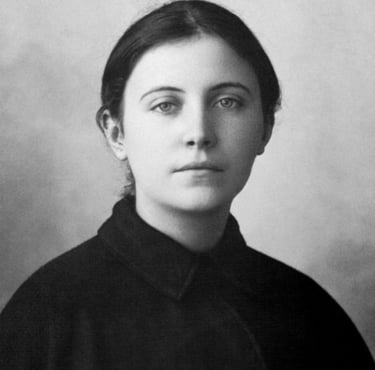
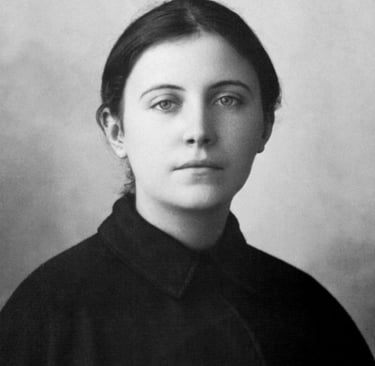
As noted in the About section, the idea for Doubting Nikki — A Tale of Faith and Delusion was inspired, in part, by family lore that says we are related to Saint Gemma Galgani (1878-1903), a stigmata who displayed the wounds of Christ on the cross.
As they say, I can neither confirm nor deny the truth of such claims. But she was born in the hamlet of Camigliano near Lucca, Italy in 1878. My father's parents and other relatives also came from Lucca, and his middle name was Arno, a river that runs through the region.
I’ve come to learn that Galgani is a more common surname than I imagined as a kid, which raises questions about the veracity of claims of such a heritage. But we did grow up being told that our side of the clan shares a lineage with St. Gemma.
I don’t remember when, but I do remember hearing at some point that St. Gemma, on multiple occasions during her short life, displayed the wounds Jesus suffered during the crucifixion: holes in his hands and feet when nailed to the cross, and a gash in his side when speared by a Roman guard. I always assumed St. Gemma exhibited the superficial appearance of wounds, not actual physical injuries.
So what’s the tie-in to Doubting Nikki?
In the novel, I replaced the historical St. Gemma with the fictional character, St. Caterina — a stigmata who suffered the same wounds from the crucifixion. That narrative plays an integral role in the book, and that’s how St. Gemma’s life actually inspired the story.
But there was something I didn’t realize until later.
When sketching out the story in my head, I came up with what I thought was a clever idea — have St. Caterina literally bleed drops of blood while on the cross.
It was only after I wrote the novel that I read The Life of St. Gemma Galgani and discovered that St. Gemma did actually bleed from her wounds as a stigmata. As they say, fact can, indeed, be stranger than fiction.
An excerpt from The Life of St. Gemma Galgani describes her wounds:
A little later the skin itself broke and the opening took on all the characteristics of a fresh wound — about a centimeter in diameter in the palms and two millimeters in diameter and twenty millimeters in length on the back of the hands. Sometimes the laceration appeared to be only on the surface; at other times it was almost imperceptible to the naked eye. As a rule, however, it was very deep and seemed that it would pass through the hand and the upper and lower wounds would meet. One could not make certain of this latter appearance because the apertures were filled blood, in part congealed but for the most part freely flowing, and when the blood stopped, they closed quickly.
And this:
The blood that came from the aforementioned wound was copious, as could be seen from her under-garments, which were soaked with it. She did her best to hide this fact and made use of several folds of linen, which she applied to her side repeatedly, but in a short time they were blood-soaked.
Because St. Gemma physically manifested the wounds of Christ, many revere her as a mystic and refer to her as the "Daughter of the Passion.”
Everyone can, of course, choose to believe or not believe that St. Gemma “miraculously” displayed the wounds of Christ. Particularly because now more than a century has elapsed since these hard-to-believe phenomena took place and all eye witnesses have long since passed, it requires a leap of faith to believe in these events. But isn't the opposite also true? Doesn't it take a leap of faith to believe such events are impossible simply because they're improbable?
That gets at the underlying theme of Doubting Nikki.
As Nonna, a key character in the novel notes on multiple occasions, believing or not believing doesn’t change the truth. And what one person faithfully believes, another may dismiss as pure delusion.
We often reflexively view “science” as fact, and everything not empirically provable as mere faith, speculation or superstition. But scientists are — or at least should be — willing to admit that science is neither infallible nor impervious to change nor immune to influence by one's own belief or ego.
To be sure, much of our physical world can be verified using the scientific method. But does that constitute the entirety of what exists and is real and true?
Personally, I think it takes a leap of faith to believe that.
Photo courtesy of StGemmaGalgani.com